New page opened at the top.

Tap to contact us

RYDEI ARTICLE · MEDICAL PLANNING PALATKA / PUTNAM COUNTY

Senior transportation in Palatka and Putnam County.

Finding transportation becomes more important when an older adult stops driving, needs help getting to an appointment, or needs a dependable way to handle groceries and everyday errands. This local guide explains where seniors, families, and caregivers can start in Putnam County, Florida.

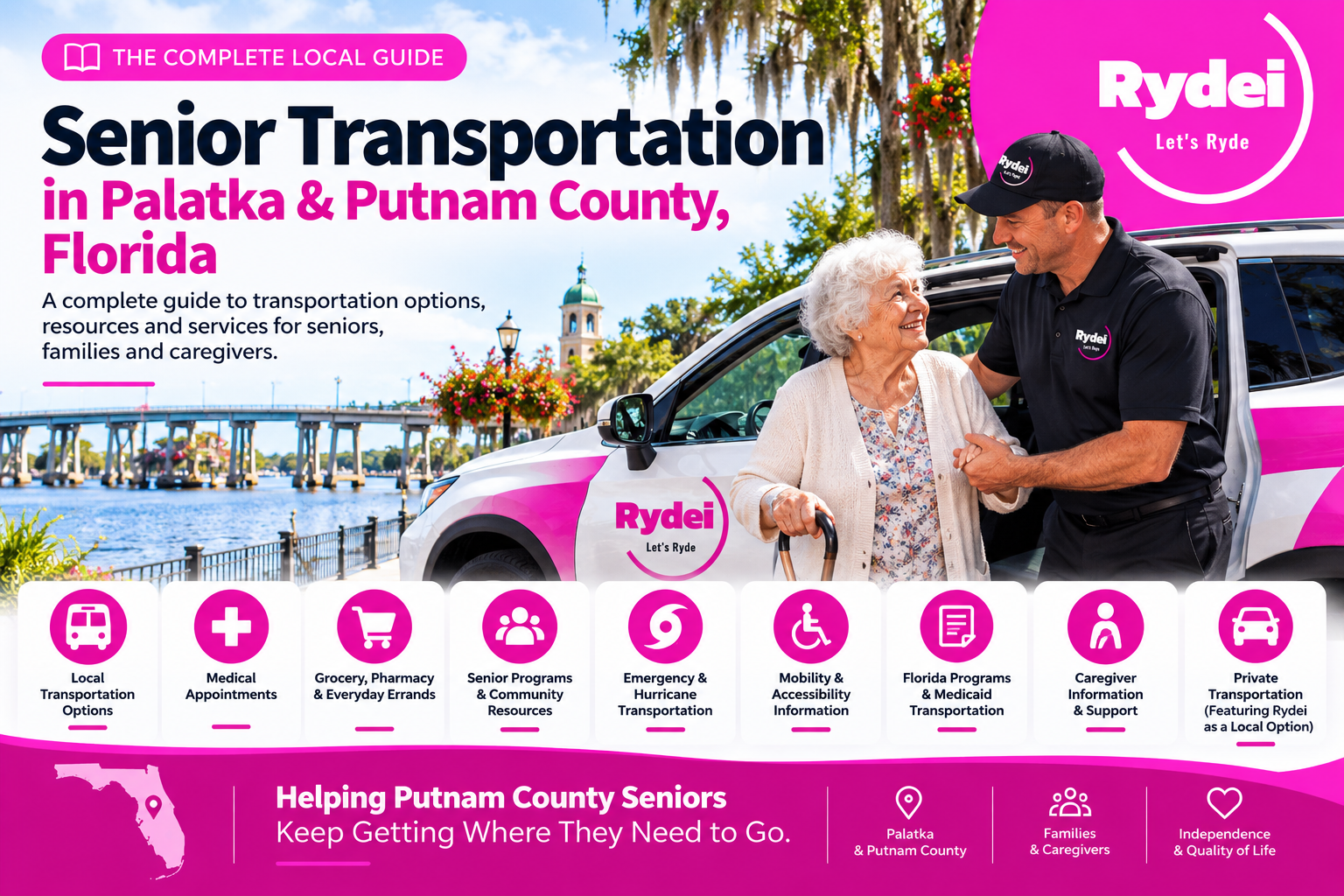
Senior transportation guide for Palatka and Putnam County showing an older passenger with a Rydei driver beside a branded vehicle
SHARE THIS GUIDE
ARTICLE SUMMARY

Get practical appointment details ready.

Older adults in Palatka and Putnam County may have options through The Ride Solution, qualifying Florida aging or health programs, referral resources, and emergency-only county assistance. The right agency must confirm eligibility, trip purpose, timing, mobility needs, fare, and availability before a ride is arranged.

This is an informational starting point, not a guarantee of eligibility, coverage, fare, accessibility, scheduling, or ride availability. Contact each agency or provider directly to confirm current details before making arrangements.

Check The Ride Solution's official resources Explore Senior Transportation
  1. 01Identify the kind of trip: public transportation, a program-covered ride, a private ride, or emergency evacuation assistance.
  2. 02Call the appropriate agency or provider early and ask what the rider and trip qualify for.
  3. 03Keep a backup transportation plan for appointments, errands, and emergencies.
QUICK ANSWERS

What to know before you book.

What is the short answer about Senior transportation in Palatka and Putnam County?

Older adults in Palatka and Putnam County may have options through The Ride Solution, qualifying Florida aging or health programs, referral resources, and emergency-only county assistance. The right agency must confirm eligibility, trip purpose, timing, mobility needs, fare, and availability before a ride is arranged.

What should I have ready before using this guide?

Have the exact pickup and destination, date, requested time, passenger count, and any luggage, access, child-seat, or mobility details that affect the request. This is an informational starting point, not a guarantee of eligibility, coverage, fare, accessibility, scheduling, or ride availability. Contact each agency or provider directly to confirm current details before making arrangements.

What happens after I send the request?

The request follows the existing Senior Transportation process for review. A guide or submitted request does not by itself guarantee a driver, fare, availability, timing, or confirmation.

WHAT HAPPENS NEXT?

A simple path from trip details to booking.

Use the guide to prepare the details, then follow the actual Rydei handoff. The guide does not create a confirmed ride or collect raw card information.

  1. Set the planStart with the route or service described in this guide and decide what you need the trip to accomplish.
  2. Enter the detailsEnter the exact locations, date, requested timing, passengers, and practical trip details through the existing Senior Transportation path.
  3. Review the requestSubmit the request and review the current choices or handoff; do not treat the guide text as a live quote or confirmation.
  4. Follow the confirmed next stepFollow the trip-specific response before relying on the ride, and never send raw card numbers in an ordinary message.
01

Quick answer: where should a family start?

Start by identifying what kind of transportation is needed. A normal local or community trip, a program-based trip, a medical appointment, a private ride, and emergency evacuation assistance are different situations with different rules.

For general Putnam County community transportation, begin with The Ride Solution. For a Florida aging or Medicaid program, begin with the plan, case manager, ADRC, or Elder Helpline. For a private ride, contact the provider directly and ask what it can actually accommodate.

  • Community transportation: The Ride Solution, 386-325-9999.
  • Program questions: Florida Elder Helpline, 1-800-963-5337.
  • Putnam County Elder Helpline listing: 800-262-2243.
  • Declared emergency with no evacuation plan: Putnam County Special Needs Registry.
02

1. Why senior transportation matters

Transportation is easy to take for granted when a person can drive. When an older adult stops driving, a doctor visit, prescription pickup, grocery trip, or visit with family can become a much bigger problem.

A good transportation plan is about more than finding one ride. It helps a senior keep appointments, stay connected, handle everyday needs, and know what to do if the first option is not available.

  • Keep medical appointments and follow-up visits.
  • Pick up prescriptions and groceries.
  • Stay connected to family, church, senior programs, and friends.
  • Have a backup before a planned ride falls through.
03

2. The Ride Solution and Putnam County community transportation

The Ride Solution is one of the main community transportation resources for Putnam County. Its official materials describe city, county, flex, Transportation Disadvantaged, paratransit, and other program-related services. The provider also publishes information about non-emergency medical transportation and some regional connections.

The Ride Solution lists its office at 220 North 11th Street, Palatka, Florida 32177, with the phone number 386-325-9999. Call before depending on a route, fare, schedule, mobility accommodation, or regional trip because the provider must confirm the details for the actual passenger.

  • The service area described in official materials includes Palatka, East Palatka, Interlachen, Satsuma, San Mateo, Welaka, Georgetown, Crescent City, Lake Como, Pomona Park, and other scheduled or on-demand points.
  • Regional connections described in the materials include St. Augustine, Gainesville, Jacksonville, Green Cove Springs, and Orange Park.
  • The provider's Transportation Disadvantaged plan says a trip request does not ensure transportation.
04

3. Transportation through Florida senior programs

The Florida Department of Elder Affairs explains that transportation may be available through certain programs for eligible participants. Examples named by the state include Community Care for the Elderly, Home Care for the Elderly, the Alzheimer's Disease Initiative, Local Service Programs, and Older Americans Act programs.

These programs do not work like a universal taxi service. Enrollment, functional needs, covered services, local arrangements, and available funding can affect what is offered. Ask the program, local ADRC, or case manager to confirm the specific trip.

  • Ask which program or plan applies to the senior.
  • Ask whether transportation is available for the exact destination and purpose.
  • Ask who actually schedules or provides the ride.
  • Ask how much notice and what documentation are required.
05

4. Florida Elder Helpline and Community Care for the Elderly

The Florida Elder Helpline is a good starting point when a senior or caregiver does not know which program to call. The statewide number is 1-800-963-5337, and the Florida Department of Elder Affairs lists 800-262-2243 for Putnam County.

Community Care for the Elderly may include transportation for eligible adults age 60 or older who are functionally impaired. The program uses assessment and local service arrangements, so a person should ask the Elder Helpline or local ADRC what steps apply instead of assuming transportation is automatic.

  • The Elder Helpline provides information and referral, not a guaranteed ride.
  • CCE eligibility is based on more than age alone.
  • Relay numbers listed by the state are 1-800-955-8771 TDD and 1-800-955-8770 Voice.
06

5. Medicaid transportation: what to ask

Florida's official transportation guidance says certain Statewide Medicaid Managed Care Long-Term Care plans provide non-emergency transportation for enrolled members traveling to covered services. The member should look for the transportation provider on the health-plan identification card or ask a case manager for help.

That does not mean every Medicaid member has every ride covered. Ask whether the person is enrolled in the qualifying plan, whether the destination is a covered service, how far ahead to schedule, and what happens if the appointment runs late.

  • Have the Medicaid or health-plan card available.
  • Ask the plan or case manager about the transportation provider.
  • Confirm the trip is for a covered service.
  • Do not assume a private ride will be reimbursed unless the plan confirms it.
07

6. Transportation to medical appointments

Medical trips can include a doctor, specialist, dialysis, physical therapy, lab, imaging, dental, hospital, or follow-up appointment. The first step is to check whether a health plan, Medicaid plan, aging program, or community transportation resource can help.

If a private ride is being considered, give the provider the appointment time, the time the passenger needs to arrive, the expected return plan, and any mobility or equipment detail that affects the ride. A private transportation request is not the same thing as medical care or medical monitoring.

  • Ask whether the trip is non-emergency transportation.
  • Call 911 for a medical emergency instead of arranging a ride through an article.
  • Confirm whether the passenger can walk, transfer, or ride with a cane, walker, or wheelchair.
  • Ask whether a caregiver or attendant can ride.
08

7. Groceries, pharmacies, and everyday errands

Senior transportation is not only about medical appointments. A ride to a grocery store, pharmacy, bank, haircut, church, shopping trip, senior activity, or family home can help an older adult maintain independence and community connection.

For everyday transportation, explain the real trip instead of only saying ‘senior ride.’ Include the pickup, destination, date, time, passengers, and whether the ride is one way or round trip. If someone needs an item picked up on their behalf, ask about an errand service rather than assuming a passenger ride includes that task.

  • Grocery and pharmacy trips.
  • Banking, shopping, and personal business.
  • Church, senior activities, and visits with family.
  • Non-medical appointments and local community trips.
09

8. What if a senior no longer drives?

Giving up driving does not have to mean giving up independence. It helps to create a simple plan before a ride is urgently needed, especially when family members live in another town or work during the day.

Use one main option for ordinary trips, one backup option, a program or community resource to investigate, a private option to call when appropriate, and an emergency plan for severe weather. Write the important phone numbers down where the senior and caregiver can find them.

  • Primary community or family transportation option.
  • Backup private or family option.
  • Program or Elder Helpline contact.
  • Emergency and evacuation plan.
10

9. Mobility limitations and accessibility questions

A person who walks independently has different transportation needs from someone who uses a cane, walker, wheelchair, oxygen, or other equipment. The words ‘senior transportation’ do not automatically tell a provider what the vehicle or passenger will need.

Ask the actual provider about the specific equipment, transfer ability, attendant, vehicle, and trip. The Ride Solution's official materials describe certain wheelchair, stretcher, and paratransit services, but those details must be confirmed for the rider and trip. Do not assume a private provider has the same capability.

  • Can the passenger walk to and from the vehicle?
  • Can the passenger transfer independently?
  • Will a cane, walker, wheelchair, or other equipment travel with the passenger?
  • Is a caregiver or attendant required?
  • Does the provider offer the specific vehicle and service needed?
11

10. How caregivers can arrange transportation

A family member or caregiver can often help organize the details even when the senior is the passenger. The most useful information is practical: where to pick up, where to go, when the appointment begins, how the passenger moves, and who should be contacted if plans change.

If you are arranging a ride from another city, tell the provider that you are the caregiver and provide the passenger's phone number, your number, and an emergency contact when appropriate. Avoid putting private medical information into a general transportation request.

  • Passenger name and direct phone number.
  • Full pickup address and access instructions.
  • Destination building or department.
  • Mobility equipment and transfer information.
  • Caregiver and emergency contact.
  • One-way or round-trip details.
12

11. Getting around Palatka and Putnam County

Putnam County includes more than Palatka. Transportation planning may involve East Palatka, Interlachen, Crescent City, Welaka, Satsuma, San Mateo, Pomona Park, Georgetown, or a rural address outside town.

Availability can change based on the exact pickup address, destination, route, day, funding category, and the provider's schedule. Give the complete address when calling rather than assuming that service in one town means the same service is available at every nearby address.

  • Use the exact pickup address whenever possible.
  • Mention gates, apartment buildings, long driveways, or rural access details.
  • Confirm whether the destination is inside the provider's current service area.
13

12. Trips outside Putnam County

Some seniors need to travel to Jacksonville, Gainesville, St. Augustine, Orange Park, Daytona Beach, Orlando, an airport, a medical facility, or a family home outside the county. A local community route may not fit a longer trip, so ask the provider what regional options exist.

Private transportation may be useful for some longer-distance requests because it is arranged directly with a company, but it still requires a direct confirmation of service area, price, vehicle, schedule, and cancellation terms.

  • Ask whether the trip is local, regional, or long-distance.
  • Confirm the return plan before the outbound ride.
  • Ask whether waiting time is included or handled separately.
  • Compare the total trip cost and cancellation policy before agreeing.
14

13. Emergency and hurricane transportation

Routine senior transportation and emergency evacuation transportation are not the same thing. Putnam County's Special Needs and Evacuation Assistance Program is intended for qualifying residents with no other evacuation plan during a declared emergency, an ordered evacuation, and opened shelters.

The county says transportation may be provided to a general shelter, special-needs shelter, or healthcare facility. Register and plan before a storm. Registration leads to follow-up and eligibility review, but it is not a guarantee of a ride, shelter placement, or hospital care.

  • Use the Putnam County Special Needs Registry for emergency planning.
  • Do not wait until high winds or an evacuation deadline to start planning.
  • Keep medications, identification, contacts, and equipment information ready.
  • Call 911 for an immediate life-threatening emergency.
15

14. What to have ready when booking a senior ride

The more complete the request, the easier it is for a provider to say what it can and cannot do. Read the details back as if another person had to find the address and understand the schedule.

For a medical appointment, include both the arrival requirement and the return plan. For an everyday trip, include the number of stops and whether someone is traveling with the senior.

  • Full pickup address, unit number, gate, and access instructions.
  • Destination address, facility name, entrance, or department.
  • Passenger name, phone number, and number of passengers.
  • Date, appointment time, pickup time, and return time.
  • Cane, walker, wheelchair, transfer, caregiver, or attendant details.
16

15. How far ahead should transportation be arranged?

There is no single booking window for every transportation option. The Ride Solution's Transportation Disadvantaged materials generally describe reservations by noon on the prior workday, with weekend reservations generally made by Friday at noon, but current service rules should be confirmed directly.

Program transportation, medical appointments, regional trips, private rides, and emergency assistance may each have different timing. Call early, especially for a first ride, a long-distance trip, a mobility accommodation, or an appointment that cannot be missed.

  • Ask the provider's current reservation cutoff.
  • Book earlier for appointments and return trips.
  • Confirm weekends, holidays, rural pickups, and long-distance travel.
  • Have a backup if the first provider cannot confirm the trip.
17

16. How to compare transportation options

There is not one best option for every senior. Public or community transportation may fit a local trip, a program may fit an eligible covered service, family transportation may fit a familiar schedule, and private transportation may fit a direct request that needs flexible planning.

Compare the things that affect the actual trip: service area, eligibility, cost, reservation window, vehicle, mobility accommodations, caregiver policy, waiting time, return plan, and cancellation rules.

  • Public/community transportation.
  • Program-based transportation.
  • Family or caregiver transportation.
  • Private transportation.
  • Emergency evacuation assistance when officially activated.
18

17. Questions to ask any transportation provider

Before relying on a transportation provider, ask direct questions and write down the answer. This is especially important when a senior has an appointment, uses equipment, or needs someone else to coordinate the ride.

A clear answer is more useful than a general promise. If the provider cannot confirm a needed feature, keep looking for another option or ask a referral resource for help.

  • Do you serve my pickup address and destination?
  • Is the price one way or round trip?
  • How far ahead should I book?
  • Can a caregiver ride?
  • Can you accommodate the specific mobility equipment?
  • Will the same driver handle the trip?
  • What happens if the appointment runs late?
  • What is the cancellation policy?
19

18. Important Putnam County and Florida resources

The resource links below are starting points, not guarantees. Phone numbers, schedules, fares, eligibility, emergency activation, and provider arrangements can change, so verify the details directly before making a transportation plan.

The Ride Solution is the main community transportation contact in the local resource list. The Florida Department of Elder Affairs and Elder Helpline can help identify program-based resources. Putnam County Emergency Management is the source for emergency registry and evacuation-assistance planning.

  • The Ride Solution: 220 North 11th Street, Palatka, FL 32177; 386-325-9999.
  • Florida Elder Helpline: 1-800-963-5337; Putnam County listing: 800-262-2243.
  • Putnam County Emergency Management: 2509 Crill Avenue, Palatka, FL 32177; 386-329-0205.
  • Edgar Johnson Senior Center: 1215 Westover Drive, Palatka, FL 32177; 386-329-0469. Confirm current programming directly; it is listed as a senior/community resource, not a transportation provider.
20

19. Private transportation in Putnam County

Private transportation is arranged directly with a transportation company rather than through a public route or an eligibility program. It may be useful for local rides, appointments, errands, airports, hotels, longer-distance trips, or family-arranged transportation.

Ask the company what it actually provides. Confirm the service area, price, vehicle, mobility accommodations, caregiver policy, waiting time, cancellation policy, and how the ride becomes confirmed. Do not assume a private company accepts Medicare or Medicaid unless that coverage is specifically verified.

  • Private transportation is not automatically medical transportation.
  • A private provider may have different vehicle and mobility limits than a public program.
  • A request is not a confirmed ride until the provider confirms the details.
21

20. Rydei private transportation

Rydei is a private transportation option serving Palatka, Putnam County, and surrounding Northeast Florida communities. Rydei can be contacted by a senior, family member, or caregiver who wants to discuss a local ride, appointment, errand, airport, hotel, or longer-distance request.

Rydei is not a Medicaid or Medicare program. When contacting Rydei, provide the pickup address, destination, date, preferred time, passenger count, mobility information, caregiver details, and whether the trip is one way or round trip. Rydei must review the actual request and confirm what is available.

  • Phone: 386-213-7485.
  • Website: https://gorydei.com.
  • Use the existing senior transportation or booking path for the current request.
  • Do not send payment-card numbers in an article, text, or ordinary message.
22

21. A simple transportation plan for a senior

A written plan reduces stress when the next appointment or errand arrives. Put the important contacts near the phone and share a copy with the caregiver or family member who may need to arrange a ride.

Review the plan when the senior's mobility, health, living arrangement, appointment schedule, or preferred transportation changes. A plan that worked last year may not fit the next trip.

  • Primary transportation option.
  • Backup transportation option.
  • Program or Elder Helpline contact.
  • Private transportation contact.
  • Emergency evacuation plan.
  • Family or caregiver contact.
23

22. Final reminder for seniors and caregivers

The goal is not simply to find a ride. It is to help people in Putnam County keep getting where they need to go, whether that means a doctor, a grocery store, a pharmacy, a senior activity, a family home, or a safe shelter during an activated emergency.

Start early, ask specific questions, and keep a backup plan. Public resources, Florida programs, referral services, private transportation, and emergency assistance each have different rules. The agency or provider must confirm the details for the actual person and trip.

  • Confirm eligibility before assuming coverage.
  • Confirm the vehicle and mobility fit.
  • Confirm the pickup, timing, return plan, and cost.
  • Keep emergency transportation separate from routine ride planning.
QUICK ANSWERS

Frequently Asked Questions

These answers are planning guidance. They do not replace current booking details or emergency help.

Is there transportation for seniors in Palatka?+

Yes, there may be several starting points, including The Ride Solution, qualifying Florida aging-service programs, and private transportation arranged directly with a provider. Eligibility, route, timing, mobility accommodations, and availability must be confirmed for the specific rider and trip.

Does Medicaid provide transportation for seniors in Florida?+

Some enrolled members may receive non-emergency transportation through a qualifying Medicaid managed-care or long-term-care plan for covered services. Contact the plan shown on the member card or the case manager because Medicaid transportation is not automatically available for every person or every trip.

Can seniors get transportation to medical appointments?+

Possibly. The Ride Solution and some Florida programs describe non-emergency or program-based transportation, while private transportation may be another option when a program does not apply. Confirm appointment timing, eligibility, vehicle needs, and return-trip arrangements directly before relying on the ride.

What if I do not know which senior transportation program I qualify for?+

Call the Florida Elder Helpline at 1-800-963-5337, or use the Putnam County listing at 800-262-2243, for information and referral. The Helpline helps identify resources, but it does not itself guarantee or dispatch a ride.

What if I do not have transportation during a hurricane?+

Putnam County has a Special Needs and Evacuation Assistance Program for qualifying people with no other evacuation plan when an emergency is declared, an evacuation is ordered, and shelters are opened. Register and plan before a storm because registration is not a guarantee of transportation or shelter placement.

READY TO PLAN?

Enter your trip details when you are ready.

Use Rydei’s existing booking path to enter the pickup, destination, timing, and passenger details for your request. Review the current choices there; this guide does not display a live fare or guarantee availability.

  • Pickup and destination
  • Date, time, and passengers
  • Current request choices
Open booking
CHOOSE A SERVICE

Keep the next step clear.

READY TO TAKE THE NEXT STEP?Use booking with the practical details you have ready.
Book with Rydei